What makes Rust so difficult to learn?
Table of contents
What makes Rust so difficult to learn?
Rust is difficult, but not impossible. After working through The Rust Book , I understand why so many developers are drawn to it.
If you already know why it’s hard and want learning resources, skip to the end. I wouldn’t recommend Rust as a first language - it’s easier to learn if you already know another language, especially Go .
Rust was created by Graydon Hoare after an elevator incident caused by poor memory management, likely in C or C++.

Rust was created by Graydon Hoare after a problem with an elevator
Concepts that make Rust hard
Ownership and borrowing
Rust’s main goal is to eliminate common memory errors. It enforces a strict ownership model: each value has one owner. Ownership can be transferred (moved) or borrowed, but only one owner exists at a time. This makes memory leaks much harder to create.
Lifetimes
Lifetimes tell the compiler how long references are valid when it can’t infer them. Once understood, they’re manageable, but they can make code harder to read at first.

How it feels when you first read about lifetimes
You don’t need to write them often, but you’ll see them in function signatures:
fn longest<'a>(x: &'a str, y: &'a str) -> &'a str {
    if x.len() > y.len() {
        x
    } else {
        y
    }
}
Smart pointers (Box, RefCell, Cell, Arc, Mutex, Rc)
Rust has multiple smart pointers for heap allocation and shared access. Knowing when to use each - and how they differ - takes time. Mutexes in particular are common in this space.
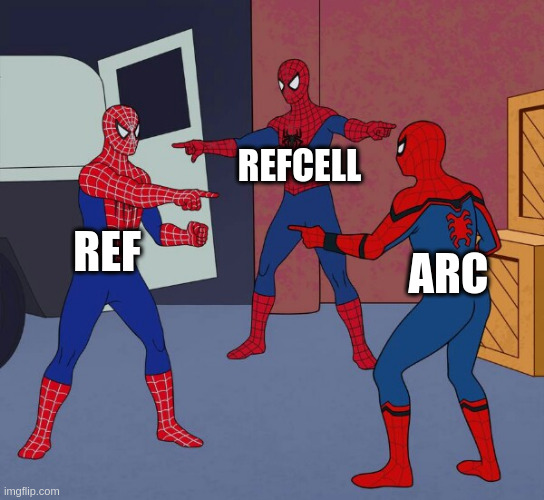
let value = Rc::new(RefCell::new(5));
Resources that helped:
let value = Rc::new(RefCell::new(5));
Tip: While researching about smart pointers I found this video, and I understood them perfectly after watching it.
Also check this simple summary of Box, Arc, Rc, RefCell and Mutex.
Macros
Macros generate Rust code at compile time. They’re common in Rust, but can be hard to read if you’re not used to #[derive(...)] or macro invocations with !.
#[derive(Debug)]
enum List {
    Cons(Rc<RefCell<i32>>, Rc<List>),
    Nil,
}
Closures
Rust closures look different from JavaScript. They use |...| for parameters and often need move to transfer ownership.
std::thread::spawn(move || {
    println!("captured {data:?} by value")
}).join().unwrap();
It takes a bit of getting used to, but the syntax becomes familiar quickly.
Error handling
Rust doesn’t use try/catch. Errors and missing values are handled explicitly with Option and Result.
This guide explains it well.
Option
Represents a value (Some) or absence (None):
let x: Option<i32> = Some(13);
let y: Option<i32> = None;
Result
Represents success (Ok) or failure (Err):
fn divide(a: i32, b: i32) -> Result<i32, String> {
    if b == 0 {
        Err("Cannot divide by zero".to_string())
    } else {
        Ok(a / b)
    }
}
expect
Returns the value or panics with a message:
let x = Some(5).expect("Value not found");
The ? operator
Propagates errors automatically:
fn read_file() -> Result<String, std::io::Error> {
    let content = std::fs::read_to_string("file.txt")?;
    Ok(content)
}
Traits, impl, and generics
Combining traits (similar to interfaces) with generics can get complex. Here’s an example from Rustlings:
use std::fmt::Display;

struct HogwartsReportCard<T> {
    grade: T,
    student_name: String,
    student_age: u8,
}

impl<T: Display> HogwartsReportCard<T> {
    fn print(&self) -> String {
        format!(
            "Hogwarts' student: {} ({}) - achieved a grade of {}",
            &self.student_name, &self.student_age, &self.grade,
        )
    }
}
Where to learn Rust
This isn’t a weekend task. Here are solid resources:
Books and guides
- The Rust Book - The official guide, available in many languages including Spanish
- Easy Rust - Great if you already know a low-level language
- Comprehensive Rust - From Google, covers Rust in depth
- Educative: Ultimate Guide to Rust Programming - Paid but concise
Videos
- Code to the Moon - Clear explanations of Rust concepts
- Let’s Get Rusty - Good tutorials and walkthroughs
Practice
- Rustlings - Small exercises to practice while reading the book
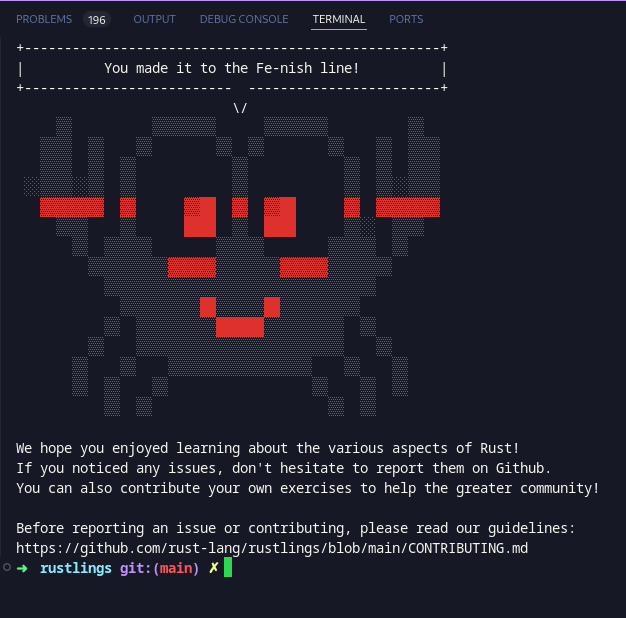
Rustling’s reward after finishing all exercises
Recommended learning path
- New to programming: Start with The Rust Book
- Know a low-level language (C/C++): Try Easy Rust or Comprehensive Rust
- Coming from JavaScript/Python: Use Comprehensive Rust or Easy Rust, and supplement with the YouTube channels above
Final thoughts
Rust isn’t the hardest language out there - Haskell is a bigger paradigm shift. It’s harder than Go or Python, and arguably harder than C to learn, but much easier to write safe code in than C.
Rust is elegant, but productivity sometimes matters more. The TypeScript team chose Go over Rust for the TypeScript compiler , which says a lot about tradeoffs.
The hard parts (ownership, borrowing, lifetimes) are a small fraction of the language. Once past them, most Rust syntax is straightforward. In exchange, you avoid many memory leaks and null pointer issues. For the right projects, that tradeoff is worth it.
Related posts
-

-

-

-

-

-