The New God: The Delirious AI Cult on Social Media
Table of contents
The New God: The Delirious AI Cult on Social Media
Today AI wrote me a 120-line function for me, fully functional and error-free, but it couldn’t refactor just two measly pages of Python functions for me; using it cost me more time than if I had done it myself from the start; it deleted functions, and modified the content of a couple, in the end I gave up. This event reminded me that I wanted to write this post.
The mockery towards those who criticize AI
Lately I’ve noticed a certain air of AI cult on social media that goes far beyond the false hypocritical corporate enthusiasm regarding this new technology; yes, people get enraged when the technical limitations of AI are mentioned by strangers on the internet, like if you made the most profane joke in front of your religious aunt.
It seems like we’re in the time of the holy inquisition, it’s impossible to expose the imperfection of AI without an army of digital inquisitors calling you a heretic.
Simple comments like: “I prefer to draw by hand”, “AI didn’t do it right so I did it myself”, “AI art cannot be protected by intellectual property laws” trigger a torrent of insults where they label you as a Luddite, anti-progress and/or a denier of technological advances,
The last time I witnessed it, was on an Instagram post. A graphic designer was defending her ability to create logos in a reel. She was comparing her logos with those of AI. Within minutes the comment section filled with teenagers (Yes, I saw their profile pictures). Their comments sought to invert her conclusion, affirming that, contrary to what the author said, it was she who had been “fooled” by AI, and not the other way around.
Art has been considered a subjective matter, even in AI times , even Ted Chiang already stated why AI isn’t going to make art . but in this case it’s not about pure art, but about design, which implies the need for communication. I agree with the creator of the reel. Undoubtedly her work was superior.
Would you go so far as to offend someone for defending AI?
Why do they take on the role of a digital bodyguard? Why take it so personally? Do they have shares in an LLM company? Did the same thing happen to them as to the Austrian painter and do they have to settle for creating paintings in Midjourney? I don’t understand.
The corporate AI cult, the obsession with productivity and the promise of infinite profits
In the corporate world there is also a cult, but I understand it. AI gurus promised investors they could get rid of most of their employees and thereby reduce their costs, raising their profits to almost the same level as their egos. This sparked strong interest and probably an AI financial bubble
It’s irrelevant whether they can do it or not. What is crucial here is to note that there is a corporate conflict of interest.
Corporate obsession with AI has conflicts of interest
The investors adopted the idea and heavily invested in turning their companies into AI-first entities, despite evidence showing that 95% of companies fail to benefit financially after AI adoption or that AI fails to complete remote projects at this same percentage .
The money they bet makes it normal for companies to proudly bear the AI banner, since their economic future depends on it being so. CEOs of related companies must promote AI as the new digital panacea, whether this is true or not.
Did they bet on the winning horse? I don’t know, and I don’t think anyone knows for sure, but it would be naive to ask for an impartial opinion on AI from the same subject who sells it.
What do studies say about AI’s effect on society?
But we don’t have to settle for such a partial opinion. Economists estimate that AI will bring infinite productivity with a demand for goods and services that tends to zero . The perfect ecosystem for an economic collapse.
According to this study, there are solutions, yes, but, in my opinion, they are ideologically complicated to implement:
- UBI (Universal Basic Income).
- Automation tax.
- Retraining programs (upskilling).
- Worker participation in company ownership.
Do AI defenders know about this? If they knew, would they change their stance?
The AI cult among younger generations
The youngest face a quite uncertain situation; if AI succeeds, they will face an employment crisis and social restructuring like never before seen. If AI doesn’t deliver what it promises, we’ll have a new dot-com crisis but with steroids.
Surprisingly it seems like this gloomy forecast has the opposite effect on youth. Their convictions that they can easily position themselves on social media by creating texts and videos with AI or creating the next unicorn with an app made with Claude Code, while looking down on illustrators and developers, remain intact.
People believe AI will come out of the digital world and save them from the “day-to-day” hardships that threaten them. They gave them an excuse to give up creating texts , illustrations, music, etc. since “AI can do it for me”.
It makes me sad, because people don’t realize how badly AI really writes (yes, even worse than me), its strong positivity bias, and how trivial it is to tell that a text was written by AI .
Do you see what happens when you don’t understand how math works?
The origin of the AI hype
Without getting into moral dilemmas about whether it’s something good or bad, I attribute this excessive enthusiasm to social media having become a propaganda machine in favor of AI. It’s impossible to navigate social media (particularly on X), without 2 out of 3 posts being related to AI.
The responsible ones? The AI bros and an environment that functions as the perfect breeding ground.
The echo chamber of the AI bros
This topic deserves a separate post, but for now a couple of paragraphs are enough. The AI bros are a quite peculiar species, a few years ago they weren’t the self-proclaimed AI bros, but rather crypto bros veterans. Now that the crypto bubble burst they migrated to AI and go around filling social timelines with FOMO, posting every week headlines as sensationalist as: “the 7 new AI tools you’ll use for the rest of your life”, “the new model that changes everything” (yes, for the fifth time this year).
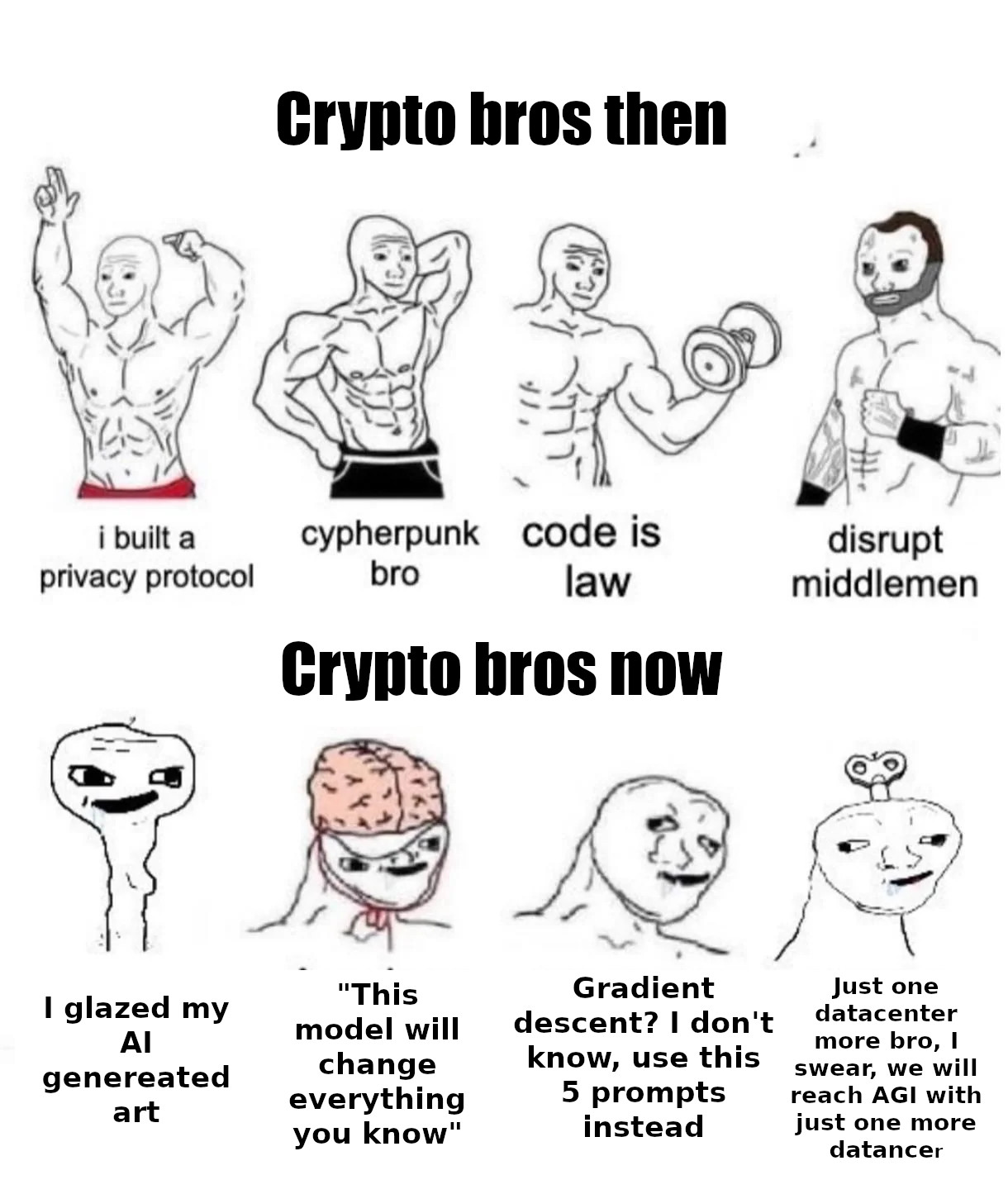
The fact that X pays for views, along with direct income from selling courses, intensifies the situation, creates the perfect echo chamber to give the illusion that AI is solving all the world’s problems while doom scrolling on social media.
The problem? The same conflict of interest as the corporate world, monetization (whether from selling courses or views) doesn’t allow an impartial vision of AI advances, since it’s not about being precise, but about the opportunity to sell the next course, or go viral. Do you remember Devin AI, the artificial intelligence that was going to replace programmers a few years ago?
AI is NOT the solution to all problems… yet
There is a delirium in society, AI will undoubtedly bring advances, and hopefully automate the mundane tasks of writing emails and corporate memos. But it’s not a wildcard to solve every one of the world’s problems, not even to always be right!
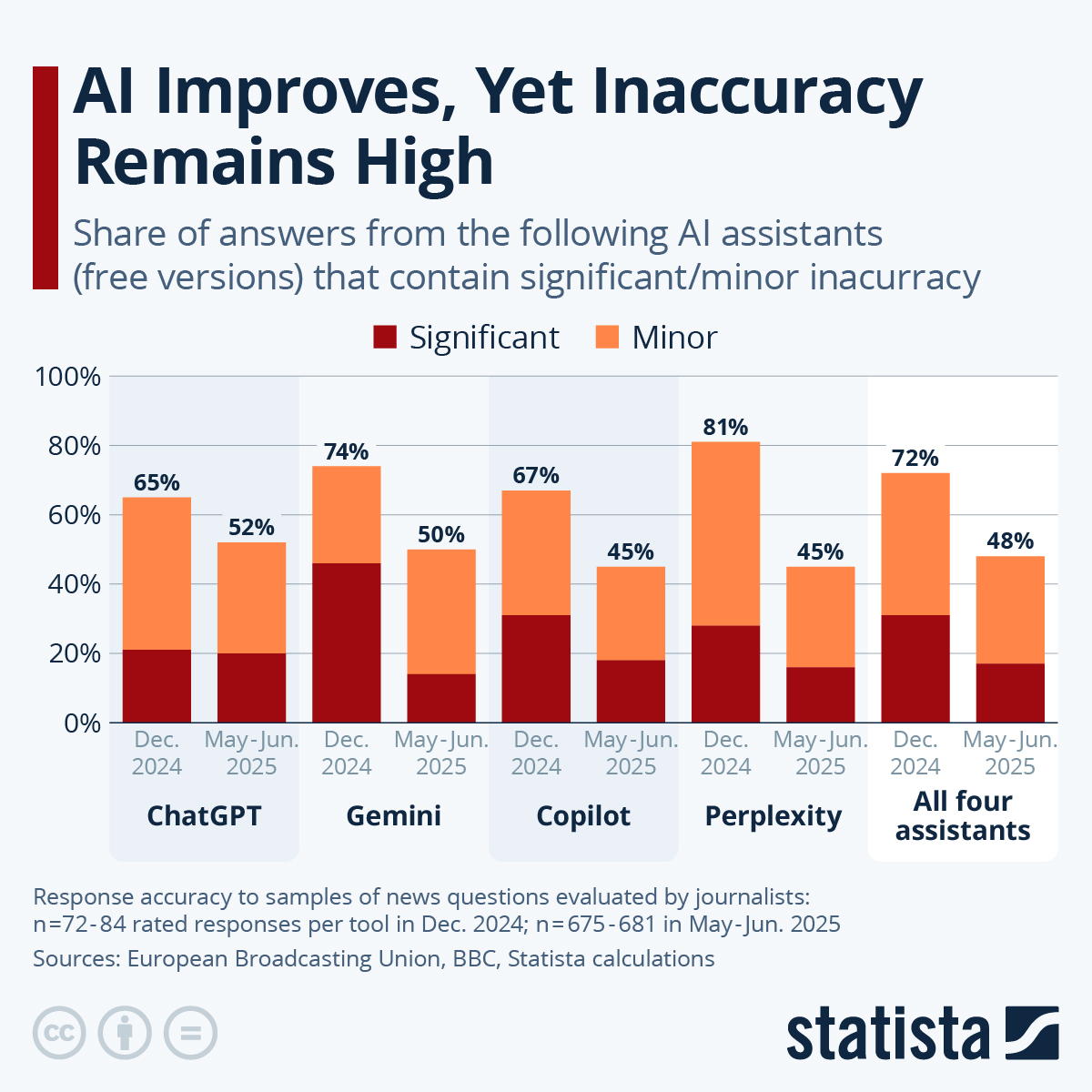
Despite having such astonishing cases like the GitLab CEO who cured his cancer or the creation of an RNA vaccine to save a dog from cancer by Paul S. Conyngham , AGI is still far away.
Prompt engineering skills are not the problem, but LLM’s core functionality
“You just didn’t use the correct prompt”, “you used the wrong model”, “AI did it better from the beginning”. I’ve used AI enough to know it’s not that simple. You need to iterate a lot, you need to be super specific and detailed. AI is useful, but it’s not magical. The non-determinism that characterizes the models doesn’t always work in your favor, sometimes the same prompt style works and other times it doesn’t.
It is precisely its non-deterministic nature that allows it, at the same time, a high capacity for adaptation, but makes it unpredictable and discards it for tasks that require repeatability and millimeter precision. Using it is not wrong in any way, depending on it and glorifying it is.
The current limits of AI
Everything I wrote is just to express my displeasure at the idea of treating AI as a deity. Doing so brings megalomaniacal delusions and other very serious problems , that seem taken from a novel co-written by William Gibson and Clive Barker.
We must not glorify matrix algorithms, no matter how sophisticated they are. AI is nothing more than a mathematical model that predicts the most probable token, convenient, yes, but just that.
Have you tried playing chess against ChatGPT? Or have you seen how AI fails miserably at Winograd schemas as soon as you move away from the most popular ones? Have you read the code it generates or its low-level proposals? It’s right there where its inability to reason becomes evident.
Searle and Penrose are still right; AI is not conscious and general intelligence may perhaps require some form of consciousness.
AGI is still very far away, if it’s even possible in the first place. But its digital knights will continue patrolling social media to confront whoever dares to blasphemy against their false silicon idol.
Related posts
-
-
-

-

-
-