Why You Shouldn't Rely On AI To Communicate In Another Language
Table of contents
Why You Shouldn't Rely On AI To Communicate In Another Language
I was looking for a famous engineering book, “Designing Data-Intensive Applications” , in Spanish the other day. I normally read technical books in English even if it’s a little uncomfortable, since translated versions are rare. Still, as a Spanish speaker, reading in my native language is much easier. If I can find a book in Spanish, I prefer to reduce cognitive load and read it there.
My search paid off: O’Reilly, the well-known technical publisher, is releasing a series of AI-translated books, including “Designing Data-Intensive Applications”. When I flipped through it, the translator’s note specified it was done with AI, though it also said the books are reviewed, presumably by humans.
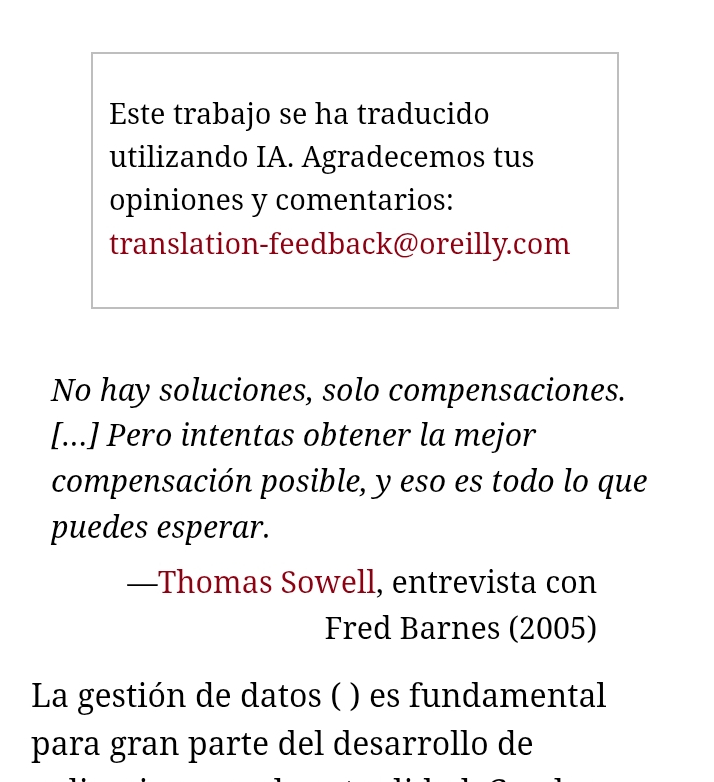
That got me thinking: most written material might soon be translated programmatically with AI, with only a handful of professional translators supervising the work.
It also made me wonder whether, in line with how AI is perceived differently by artists and developers , people will see AI as a way to skip learning another language altogether. Why bother reading a book in English, Spanish, or French when I can just have AI translate it?
They have a point. For books, it’s convenient. Automatic translation takes minutes and leaves you with a version in your native language, ready to read comfortably. But with spoken language, it’s a different story.
Books and conversations aren’t the same
A book is inert. It won’t respond or interact with you. A bad translation might make for a different experience than one done by a professional. Not all books are equal either - some, like Douglas Hofstadter’s Gödel, Escher, Bach , had fascinating translation problems I won’t spoil here.
But most don’t need that level of scrutiny or precision. Those are the exceptions.
With conversation, there’s someone on the other side. People react differently depending on how you approach them, so let me explain why.
How people react when you speak their language
Imagine pulling out your phone to talk to someone in another country. If you try to speak their language, even with imperfect pronunciation and grammar, you’ll get a very different reaction than if you pull out Google Translate to do all the talking. That’s obvious, isn’t it?
It’s a matter of perception. If I’m in my home country and a foreigner speaks my language, I’ll unconsciously treat them better. It tells me they cared enough about my culture to spend hours learning it so they could communicate better - even if all they know is “please”, “thank you”, or “how are you?”
It’s not about quality, it’s about the middleman
AI tools can help with translation, whether it’s speech-to-text or more sophisticated devices that can mimic your voice in another language. Tools like KokoroTTS, KittenTTS, or Eleven Labs might make a universal translator a reality soon.
But the issue isn’t voice quality or fluency. It’s the middleman. Its presence tells me the person didn’t consider their language worth learning, not even a few words.
That doesn’t mean we need to learn every language we encounter. Most people can’t. Even polyglots don’t speak everything on Earth.
What I mean is that using an intermediary will almost always come across as less genuine than making an effort to speak someone else’s language.
Learning a language changes how you see the world
The benefits go beyond that. Learning a language changes the way you perceive reality. Each language builds its worldview through different words, and there’s no way to understand that difference except by learning and speaking it.
Take grammatical gender. In Spanish and other Romance languages, every noun has a gender - masculine or feminine. This splits everything into one category or the other. It changes how you see things; gender takes on importance. You can notice this by using the feminine plural in Spanish-speaking countries (since masculine is the default) - I dare you to try it.
You might like that every word has a gender. But other languages do it differently. Indonesian, for example, has no grammatical gender at all - everything is neutral. It also has no complex verb conjugations tied to gender or person; context is usually enough to be understood.
Time and detail
English has only a few verb tenses to specify when something happened. Compare that to Spanish or Russian, where you need different conjugations for each person and many more tenses exist. The difference is noticeable.
For Indonesian speakers, gender is irrelevant unless they choose to specify it. Time is often implied through context, so they tend to give more details. That can create a butterfly effect in conversation, encouraging more information exchange and often leading to more fluid discussions.
Words that have no equivalent
Some languages have words for very specific situations. German has Schadenfreude - the pleasure you feel at someone else’s misfortune or failure. That word says a lot about how Germans might experience certain emotions.
Japanese has komorebi - sunlight filtering through leaves and branches. I find it fascinating that Japanese culture values that scene enough to have its own word for it.
These quirks might go unnoticed if you only speak one language, but they give you a more complete picture of how a group of people sees the world.
There are entire books on how language structure shapes perception , your relationship with color, time, people. If this interests you, it’s worth diving into them.
AI can’t do this
Immersing yourself in a language and understanding that worldview lets you connect more deeply with its speakers and form real bonds. Mimicking that subjective experience with AI is impossible.
Even if AI could transmit it, the middleman would remain as a reminder that the connection isn’t authentic - it’s artificial.
Learning another language is good for your brain
Beyond the social side, learning a language physically changes your brain. Recent studies show it can delay age-related conditions like dementia and Alzheimer’s, while also improving academic performance and memory.
Hard times ahead for polyglots
I think tough times are coming. Many of the economic incentives for learning another language are fading. Fueled by the delusional AI cult on social media , the number of bilingual people might drop even if the AI bubble bursts.
That saddens me. We’ll lose cultural richness, and we might make cross-cultural communication just a little harder because of AI.